
Commercial Water Dispenser Guide: Types, Specs, and How to Choose
Commercial water dispensers — the hot and cold units found in offices, schools, and gyms — are judged by how they fit a facility, not by headline features. This guide compares the main dispenser types and shows how to match one to your building’s plumbing, daily traffic, and hydration needs.
A commercial water dispenser is a hot and cold water unit built for shared, high-traffic use. The three main types are bottleless (plumbed) coolers, bottled top- or bottom-load coolers, and point-of-use wall or floor coolers. Choose by plumbing access, daily volume, and whether you need hot water, filtration, or ADA compliance.
01What counts as a commercial water dispenser
A commercial water dispenser is a drinking-water unit engineered for shared, repeated use in a workplace or public building, rather than the lighter-duty models sold for a single household. The category covers freestanding office coolers, countertop units, and wall- or floor-mounted coolers plumbed into a building’s water supply. What they share is a chilling system, higher-capacity components, and, in most cases, a hot tap alongside the cold.
The practical dividing line is duty cycle. Such a unit is specified to serve dozens or hundreds of people a day, so its compressor, tank, and filters are sized for that load. That is also why buyers in offices, schools, gyms, and municipal buildings compare these units on capacity and serviceability first, and on looks last.
- “Commercial” refers to duty cycle and capacity, not just size.
- Most units offer both hot and cold water on one unit.
- Plumbing access is the single biggest factor in which type you can install.
02Bottleless, bottled, and point-of-use types
Water dispensers for shared use fall into three families. Bottleless (plumbed) coolers connect directly to the water line and filter on demand, so there are no bottles to store or swap. Bottled coolers use a 3- or 5-gallon jug that loads from the top or bottom. Point-of-use wall and floor coolers are hard-plumbed fixtures, often ADA-height, common in schools and public corridors.
The table below compares the families on the attributes that actually change the buying decision. It is descriptive, not a ranking — the right family depends on your building, not on a single winner.
| Type | Water source | Temperatures | Filtration | Typical fit |
|---|---|---|---|---|
| Bottleless countertop | Plumbed line | Hot & cold | Built-in, on demand | Small offices, break rooms |
| Bottled freestanding | 3–5 gal jug | Hot or cold | Jug-dependent | Spaces without plumbing |
| Floor-mount POU cooler | Plumbed line | Cold (refrigerated) | Optional / non-filtered | Corridors, shops, gyms |
| Wall-mount ADA cooler | Plumbed line | Cold (refrigerated) | Filtered or non-filtered | Schools, public buildings |
Bottleless systems remove the recurring cost and storage of jugs and cut the plastic waste that comes with them, which is why many offices switch once a water line is reachable. Bottled units keep their place wherever plumbing is not available, such as a leased suite or a temporary site. You can browse plumbed models in our commercial water coolers collection to see current formats side by side.
03Matching a dispenser to your facility
Match a dispenser to your facility by starting with three questions: is a water line within reach, how many people use it per day, and do you need hot water for tea and instant meals? Those answers narrow the field faster than any feature list. Plumbing decides bottleless versus bottled; traffic decides capacity; hot-water demand decides the tank type.
Offices and break rooms
A break room with a nearby water line is the natural home for a bottleless countertop or freestanding cooler with hot and cold taps. It removes jug deliveries and covers the kitchen’s boiling-water needs. Where no line exists, a bottled unit fills the same role with a simple jug swap.
Schools, gyms, and public buildings
High-traffic corridors and athletic facilities lean toward hard-plumbed point-of-use coolers and hydration stations, chosen for durability and easy cleaning. In public and educational buildings, at least one accessible unit at the required height is typical, which is where wall-mounted accessible coolers and bi-level fixtures come in.
04Specs that matter: temperature, filtration, ADA, energy
The specs that most affect daily use are water temperature, filtering, accessibility (ADA) compliance, and running cost. Buyers also weigh installation and ongoing service: a plumbed unit needs a shut-off valve and periodic filter changes, while a compact countertop model saves floor space in a small break room. Stainless steel basins are common in high-traffic areas for easy cleaning and vandal protection, and lower operating costs add up over a unit’s service life. Hot-and-cold units serve the widest range of needs; cold-only coolers suit corridors and gyms. Filtration ranges from none, to carbon filters for taste, to multi-stage or reverse-osmosis systems where water quality demands it.
Accessibility and energy
In public and commercial buildings, drinking-fountain and cooler placement is governed by the U.S. ADA Accessibility Standards, which set spout-height and knee-clearance requirements — see Chapter 6, Section 602 published by the U.S. Access Board (accessed July 2026). On running cost, look for units listed under the ENERGY STAR water coolers program (accessed July 2026), which lists models that draw less standby power than conventional coolers. Specific spout heights and rated figures for a given unit should be confirmed against that unit’s own spec sheet before purchase. [A VERIFIER – specs par modele]
05Featured water coolers
The units below are current WaterStation models that illustrate each dispenser family, with published prices and manufacturer specs. Each card links to the full product page, where the complete spec sheet and compliance documentation are listed.
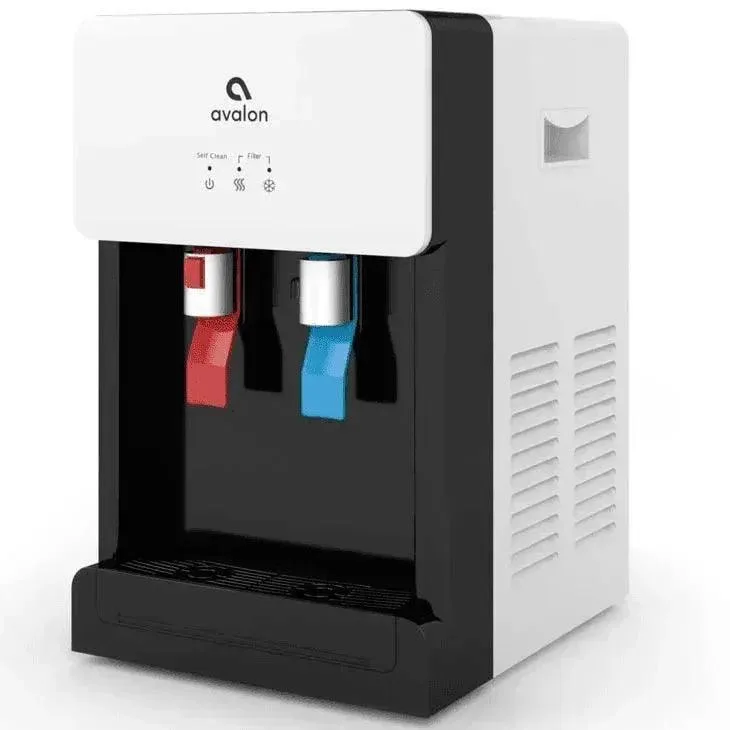
Avalon A8 Countertop Bottleless Water Cooler
Bottleless, plumbed · Hot & cold
Touchless paddle dispense

Elkay FD7003L1Z Floor-Mounted Water Cooler
Freestanding · Refrigerated, non-filtered

Elkay VRC8S Wall-Mount ADA Cooler
Wall-mount · Vandal-resistant, refrigerated

Halsey Taylor HTHB-HAC8SS-WF Cooler + Bottle Filler
Filtered, refrigerated cooler
Prices shown are the published WaterStation list prices at the time of writing and can change; the product pages carry the current figure and full specifications.
06Commercial water dispenser FAQ
What is a commercial water dispenser?
A commercial water dispenser is a drinking-water unit built for shared, high-traffic use in offices, schools, gyms, and public buildings. It usually offers hot and cold water and uses higher-capacity chilling and filtration than a household model.
What is the difference between bottleless and bottled dispensers?
A bottleless dispenser connects to the building’s water line and filters on demand, so there are no jugs to store or replace. A bottled dispenser uses a 3- or 5-gallon jug loaded from the top or bottom, which suits spaces without plumbing access.
Do these dispensers need filtration?
Not always. Some run non-filtered, others add a carbon filter for taste, and multi-stage or reverse-osmosis systems handle water that needs more treatment. The right level depends on your incoming supply and how the water is used.
Are commercial water coolers ADA compliant?
Some are. Public and commercial buildings usually require at least one accessible unit that meets the U.S. accessibility standards (the ADA) for spout height and knee clearance. Wall-mount accessible coolers and bi-level fixtures are designed for that requirement; always confirm on the model’s spec sheet.
How much does a commercial water dispenser cost?
Prices vary widely by type, filtration, and capacity. Rather than quote a figure that shifts with configuration and stock, we list current pricing on each product page — check the page for the model you are considering.
Which dispenser is right for my facility?
Start with plumbing access, daily traffic, and whether you need hot water. Plumbing decides bottleless versus bottled; traffic sets the capacity; hot-water demand sets the tank type. Schools and public corridors usually add an ADA-height unit.
- U.S. Access Board — ADA Accessibility Standards, Chapter 6 §602 Drinking Fountains. access-board.gov/ada (accessed July 2026).
- ENERGY STAR — Water Coolers product program. energystar.gov/products/water_coolers (accessed July 2026).
- WaterStation product pages — published prices and manufacturer specifications (Avalon, Elkay, Halsey Taylor).


